Distiller's Journal
How the spirits are made
Last time I told you how Milton got started. This one is about what happens between a tank of molasses and a bottle of First Rain, which is the part I absolutely love talking about, and the part where people start glazing over. There is a graph. I have put it near the end so you can see it coming.
The short version: sugar goes in, yeast turns it into a strong, flat beer, the still pulls the alcohol out of that beer and sorts the flavours, and then we rest it, age it, infuse it or filter it depending on which bottle it is heading for. Everything in the range starts that way, with one exception I will own up to when we get there.
What goes in
Molasses first. When a sugar mill crystallises cane juice, what is left behind is a thick black syrup that still carries roughly half its weight in sugar. That is molasses. Queensland and northern NSW grow the cane, with mills up and down the coast, and the molasses comes to us in 200 L drums or 1,000 L IBCs. It smells of liquorice and burnt toffee, it pours like it has somewhere better to be, and it finds its way onto surfaces you wouldn’t think possible. More on that shortly.
The other spirits start somewhere else. For A’peel, the sugar is locked up in fruit peel and off-cuts collected from Brisbane venues, so we use enzymes to break the peel down into sugar the yeast can reach. All of it goes into one blended batch; there is no lemon edition and no mandarin edition, there is just the one batch. Precedent and Frontier start as Australian grain and we mash it onsite. The exception: Agave Miel starts as a 100 per cent blue agave spirit distilled in Mexico. We bring it in under bond and redistil it here to make another cut on the spirit. We’ve experimented [read: broken our backs] ourselves with agave syrup and North Queensland agave fibres, but unfortunately we just can’t replicate the quality that Mexico can produce. Being absolutely transparent.
Fermentation, and the day the fermenter won
Water, molasses, nutrients and yeast go into the fermenter, and over the next three days the yeast eats the sugar and leaves behind alcohol, carbon dioxide and a long list of flavour compounds, which is the point of the exercise. A molasses wash finishes between 8 and 12% ABV, roughly where a strong beer sits. Brisbane from now until March is not conducive to controlled fermentations, as the temperature is too high, so we use cooling jackets on our fermenters to keep the temperature between 32 and 34 degrees.
The yeast matters more than most people expect. Saccharomyces cerevisiae, the standard distiller’s yeast, gives a cleaner ferment: pineapple, brown sugar, a soft creaminess. Schizosaccharomyces pombe is the slow one the Jamaican distilleries lean on, and it brings banana, overripe fruit and the funk. For First Rain and Stormy Skies we run both yeast strains independently and blend back to get the right flavour.
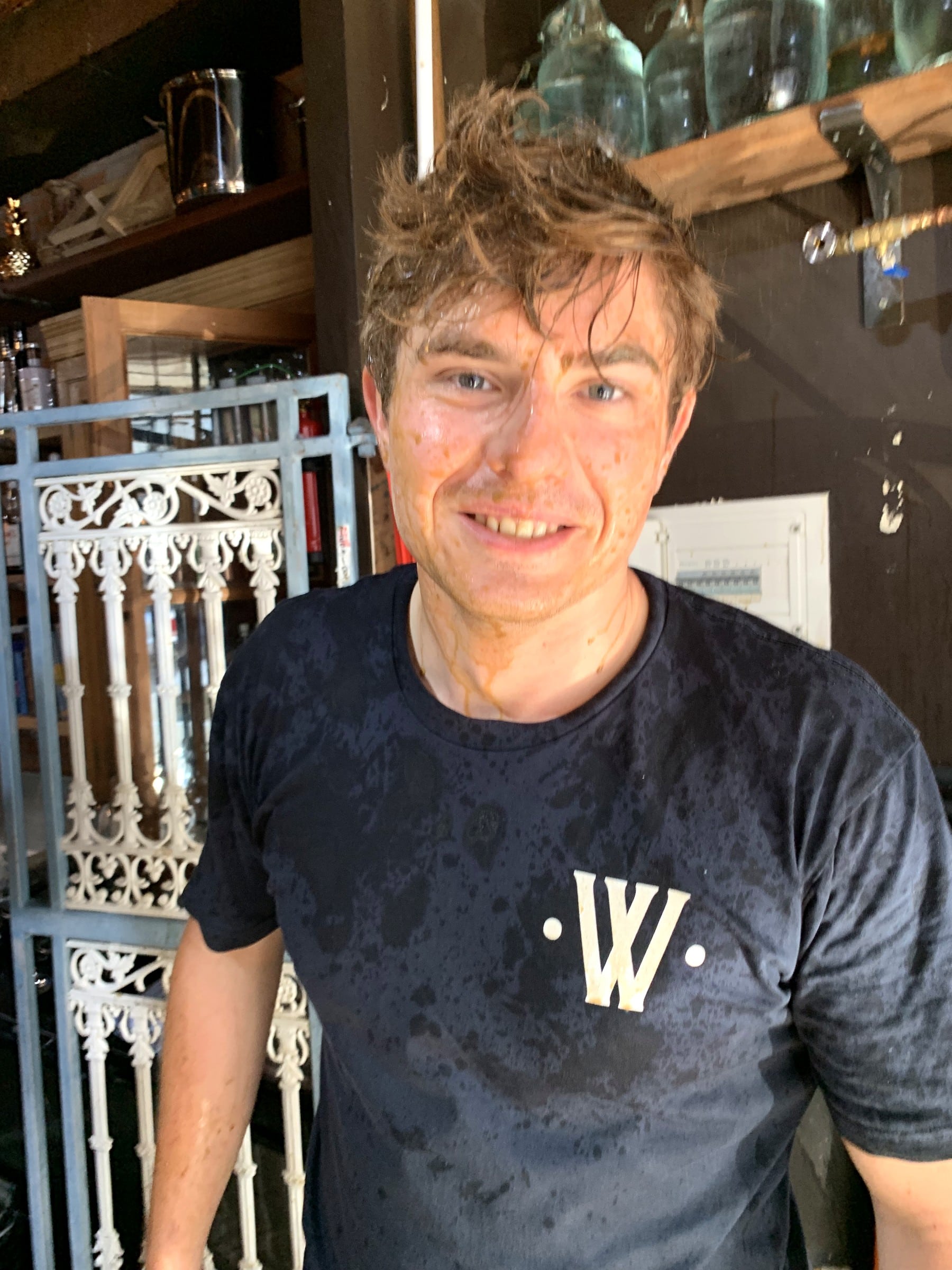
The day the fermenter won was 4 February 2019. A healthy molasses ferment has a strong, foamy layer on top of the liquid. On that day we were experimenting with a fed-batch process, where we add molasses in discrete quantities to keep yeast stress to a minimum. Good idea in theory, and the way we do it to this day, but I miscalculated how much foam the addition would create and it blasted through the tank breather, covering me and three quarters of the bar in molasses wash. This is why I now use anti-foam in every ferment.
The still
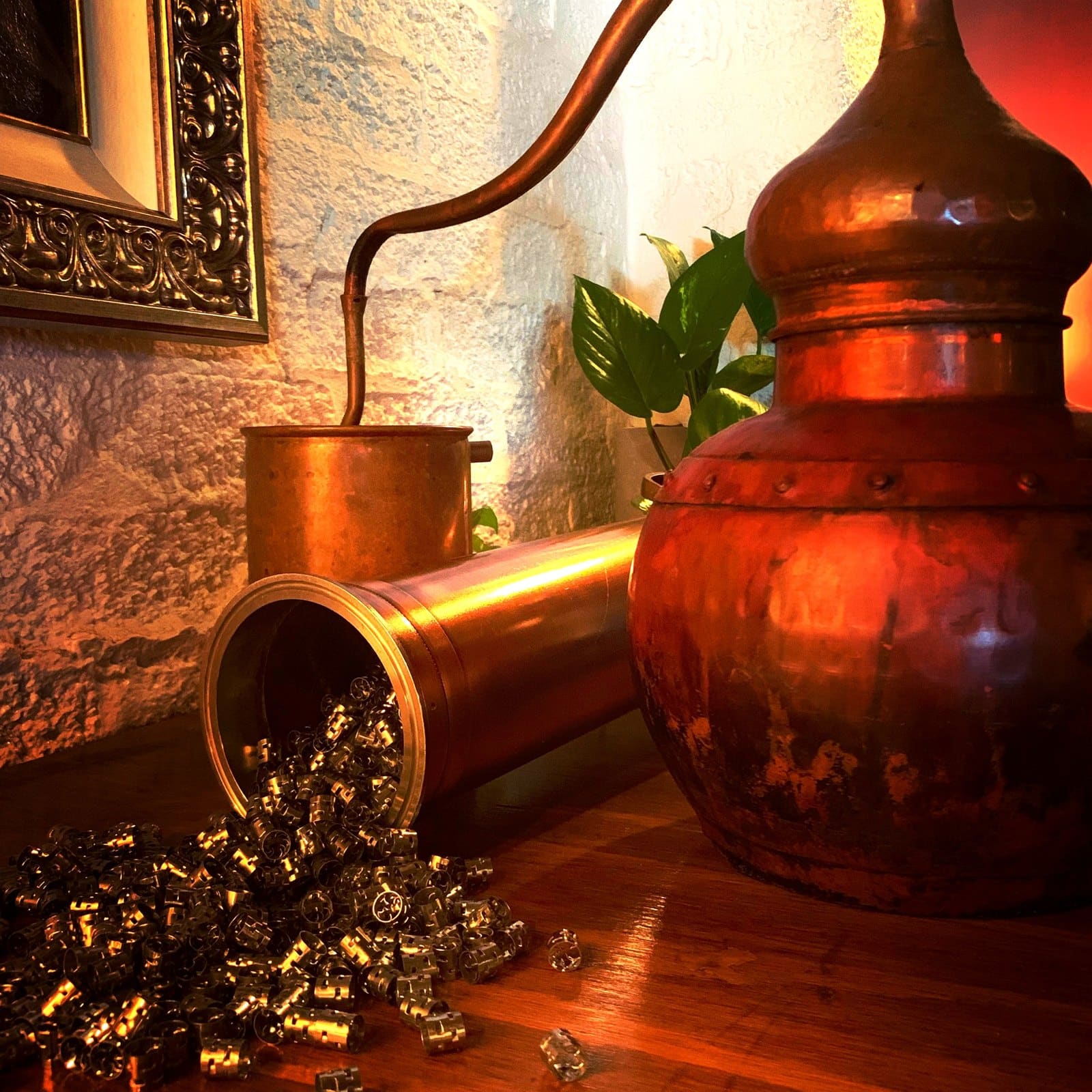
A pot still is a kettle: you boil the wash, catch the vapour, condense it, and do it again if you want it stronger. A column still is a stack of small pot stills on top of each other. Vapour rises through the column, liquid trickles down it, and at every plate or every layer of packing the two meet and swap: the vapour leaves a little richer in alcohol, the liquid a little poorer. Do that a dozen or twenty times in a tube and you get in one pass what a pot still needs two or three runs for. Make it continuous, with wash fed in at a steady rate and spirit and spent wash drawn off at a steady rate, and the still runs for as long as you keep feeding it.
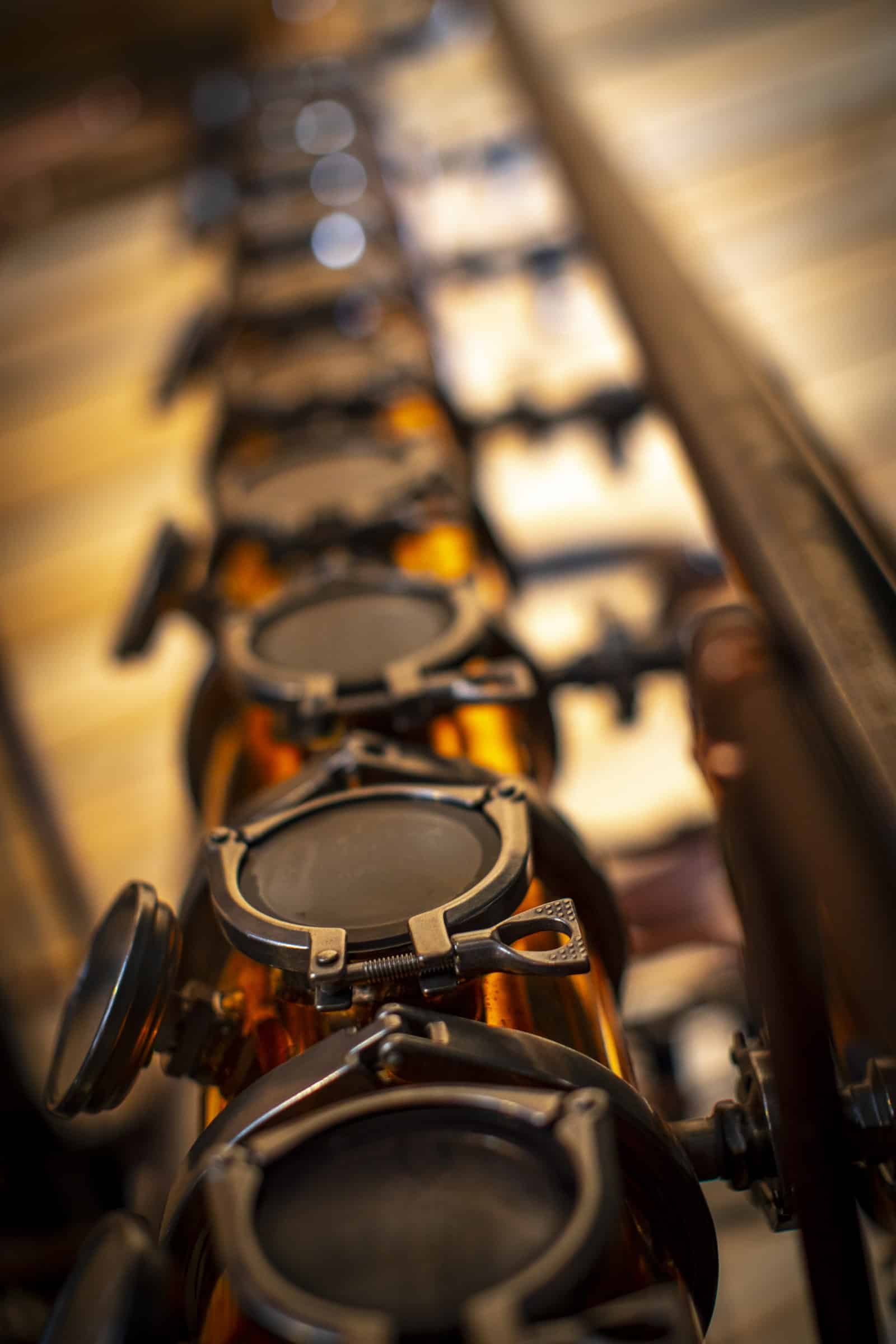
That is what saved us in 2020. When the bars closed and the sanitiser work arrived, a 300 litre pot still could not keep up, so we rebuilt the thirteen square metre distillery at the Malecón around a continuous column I designed myself. At the peak it took 20,000 litres of wash a week through a space smaller than most people’s kitchen. I describe it as one of the smallest continuous column stills in the world, and I keep saying “one of” because nobody has shown me a smaller one and I would like to keep it that way.
When the 2022 flood took that still, I built the next one (MK17) at Albion, which served us well for several years. The still we run now at 99 Jane Street, West End, is a hybrid. The stripping section runs continuously and does the heavy lifting of pulling the alcohol out of the wash. The rectifying section runs as a batch, so the cuts are made the way a pot distiller makes them, with time and a glass, but on a spirit that has already been stripped clean. There is a gin basket in the vapour path for the botanicals, which is how A’peel Gin, the original Spiced Cane Spirit and Rising Sun get their aromatics. It is heated by steam from a boiler rather than by electric elements in the pot, and it is cooled by a cooling tower rather than by running town water down the drain. The hazardous area drawings for all of this are the least glamorous and most important pieces of paper in the distillery.
Cuts
Whatever the still, the spirit that comes off is not one thing. First come the heads, the light, solventy compounds that boil off easily and that nobody wants in a glass. Then the hearts, which is the spirit we keep. Then the tails, the heavy, oily compounds that bring weight and, past a point, wet cardboard. A pot distiller separates them by time and by nose. A continuous column separates them by position, because the light compounds climb to the top of the column and the heavy ones hang lower, and the spirit is drawn from the plate where it is right. Our hybrid does it the batch way on the rectifying run, but with technology to help us land the right flavour. It does this by controlling the temperature at the top of the column, a bit like a bouncer at a nightclub: the right flavours get in, the wrong ones are turned away.
The graph
I am a chemical engineer and I could not help myself, so the models came before the still did.
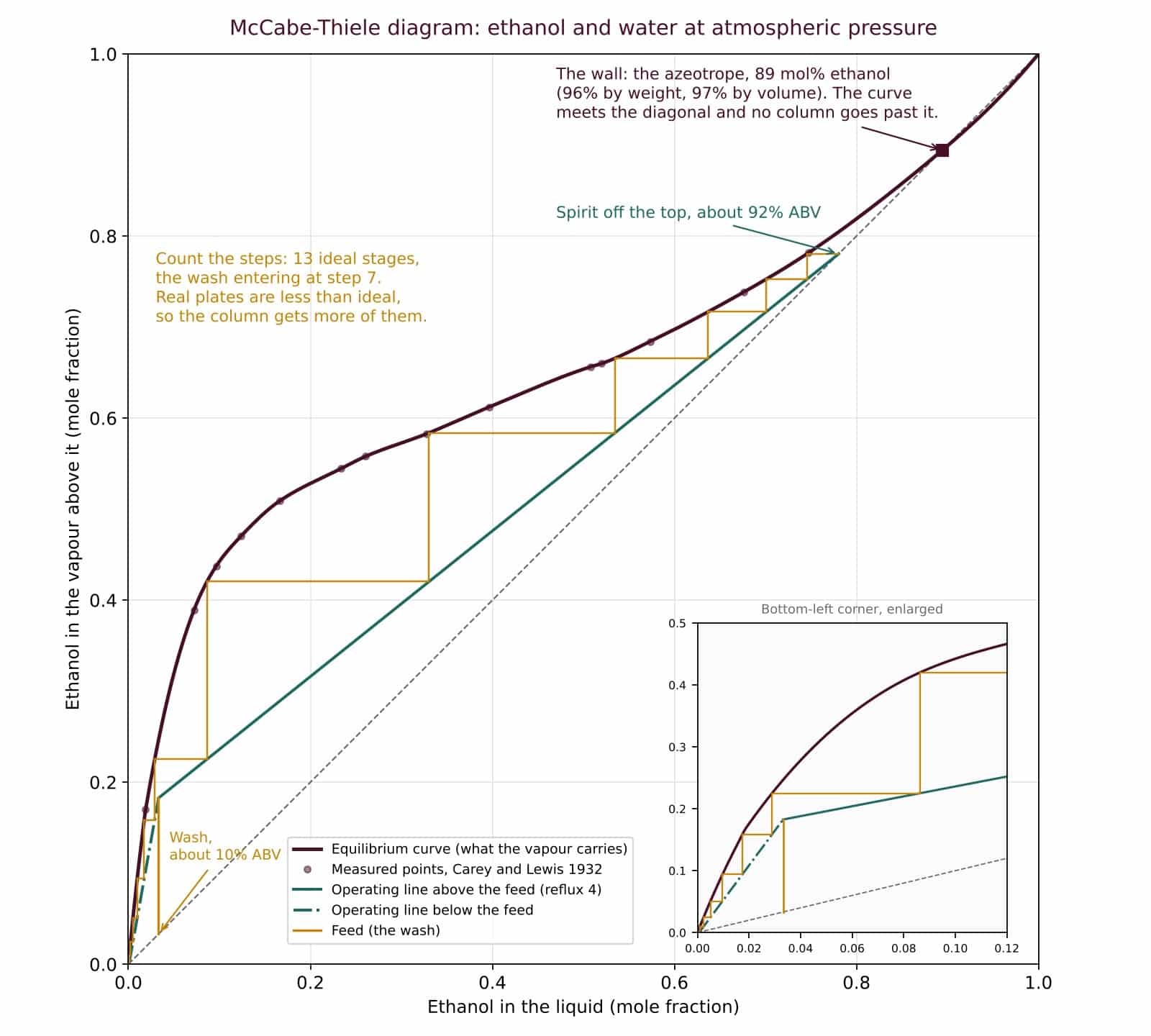
The first is a McCabe-Thiele diagram, which is a graph of how much alcohol is in the vapour against how much is in the liquid it is boiling from. You draw the equilibrium curve, draw a line for how hard you are refluxing, and step a staircase between them from the strength of your wash to the strength of your spirit. Count the steps. That is how many ideal plates you need, and that is how the first column got its height. The same graph also shows you the wall: ethanol and water form an azeotrope at about 96 per cent by weight, and no column on earth takes you past it. It doesn’t much matter for rum, but for sanitiser in 2020 it mattered a great deal.
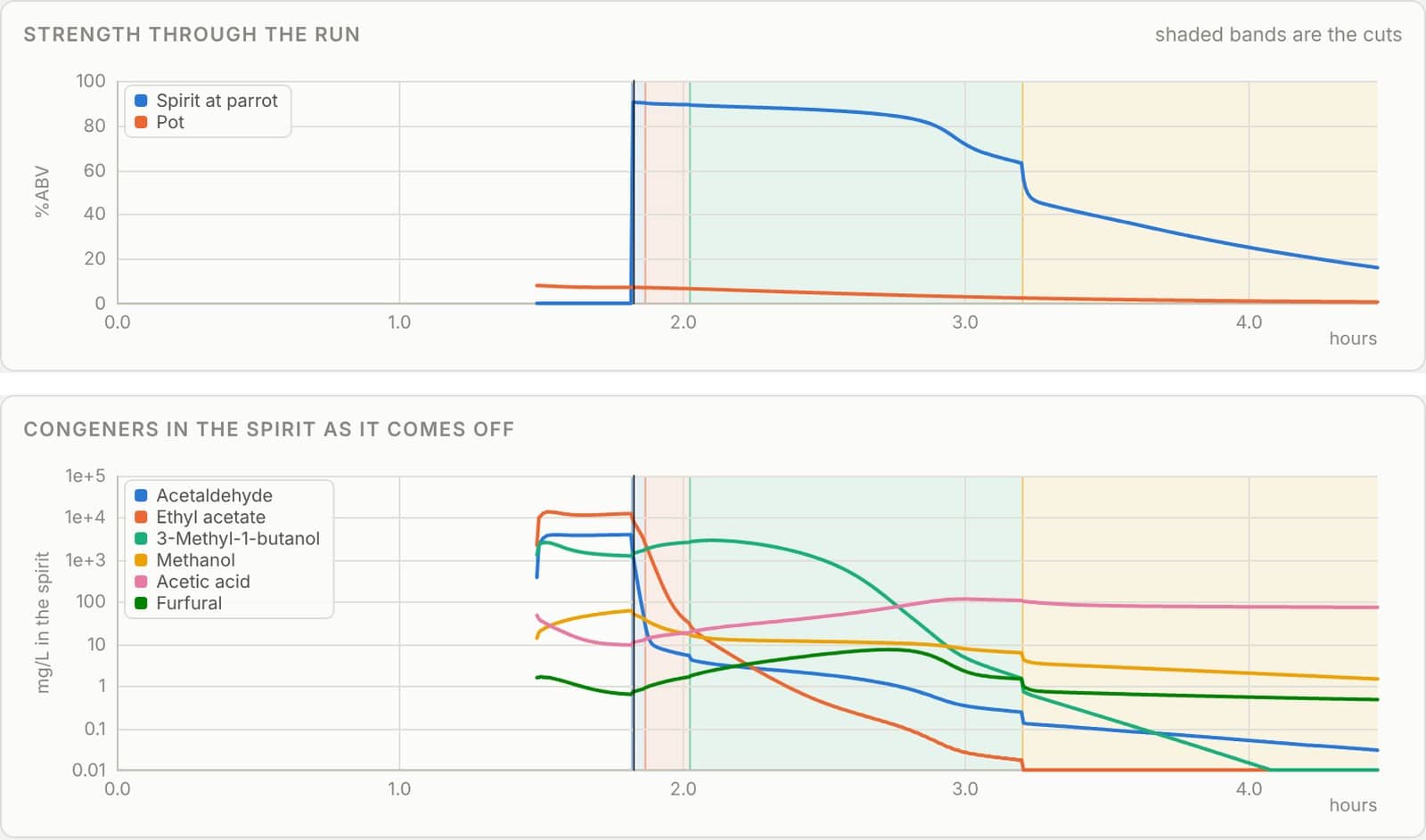
The second is a simulation of a batch fractional distillation, which predicts how the composition of what comes off the still changes through a run. In plain terms, it tells you when the hearts start and when they stop, so the model gives context to what the distiller is smelling and tasting at the parrot. The third set of models covers fermentation and ageing. Often these processes are a black box and you accept what comes out; the models give the process some context and give the distiller a fair idea of what is happening at any point. I will give the models their own post, because this one is already long and I can feel itchy fingers about to click away.
After the still: rest, wood and the reactors
First Rain is the simplest path. The spirit rests for a few weeks, is cut to 40 per cent, filtered, and goes into the bottle clear with nothing added. Resting matters even for a white spirit: the harsh edges knit together and the lime peel and underripe fruit come forward.
Stormy Skies is the same spirit after it has spent time on charred ex-bourbon, tawny and shiraz cask staves. Wood does three things to a spirit. It gives: vanilla, tannin, colour, the toffee and dried fruit you taste in anything aged. It takes: the char is a layer of activated carbon that pulls out sulphur compounds and the rougher notes. And it lets the spirit breathe, so the slow oxygen chemistry that turns alcohols and acids into fruity esters can get going. A barrel does all of this over years, loses a few per cent of its contents to the air every one of those years, and ties up a lot of capital doing very little. The spirit reactors I built in the garage before Milton existed do the same chemistry with more control and a great deal less waiting. It is a fairly simple process, but it deserves its own post. Our grain spirit, Precedent, goes through the same process with a few caveats. Again, something I am keen to share in a coming post.
Some things we still give time, because time is the point of them. Our first three year old sat in a first-fill ex-bourbon cask for three Brisbane summers. The Jumpinpin whisky spent two years in ex-bourbon oak before it went anywhere near a bottle. We say which is which on the label.
Infusions
The Spiced Cane Spirit started in 2018 as a way to use the heads and tails from the white spirit runs: rectified back to a clean base, then redistilled through a hand-built gin basket loaded with botanicals. Today it is our column-distilled cane spirit vapour-infused with fresh citrus, lemon myrtle and whole spices in smallish batches, bottled at 42% ABV. Rising Sun is made the same way but infused with cold-drip coffee, pimento, cacao and cinnamon, at a full 40% ABV, so it stirs into a Negroni instead of sweetening one. A’peel Gin is A’peel Vodka taken back through the still with leftover citrus peel from the venues and a short list of Australian botanicals in the basket.
Filtering, water and the bottle
A’peel Vodka goes through activated carbon made from recycled coconut husk, which takes out the last of what the peel left behind and leaves the citrus lift. Everything except the traditionally aged spirits is chill-filtered. Bottling temperatures in Brisbane are relatively high, so when bottles travel to the colder states or overseas the spirit can turn cloudy. There is nothing wrong with it, but the filtering keeps it looking the way it should. The water we cut with is heavily filtered, and the cut to bottling strength is done slowly, because dumping water into high-strength spirit throws a haze and warms the spirit, and the light, delicate notes evaporate off with the heat. Then the spirit is bottled and sent to the team at Help Enterprises for labelling.
Things that went wrong, a selection
- The foam. See above. Anti-foam is cheap.
- Not checking the gravity of a wash before adding the next lot of molasses. Hydrometers are cheap, and they stop you overdosing the molasses and killing your yeast.
- The 2022 flood took the still, the barrels and the first two year old, in the month they were due to be bottled. I covered that last time. It is still a sore point.
- Dirty Bird. Great idea, using bar waste and infusing it straight into alcohol to make a liqueur, but it was too wild for most [read: all] people. Hence its evolution into A’peel Vodka and Gin.
Next time
Why rum, why we call most of ours cane spirit (there is a two-year rule, and we respect it), and what we think Queensland rum should taste like. If you have a question about anything above, send it: the next post will answer the good ones.